
How to Get Court Records
Begin with the court name, not just the broad phrase "Schley County court records." Kimberly McKinney, Clerk of Superior Court, holds the Superior civil and criminal files. Sharon Miller serves as clerk for Probate and Magistrate Court. For the city route, Ellaville Municipal Court and City Hall are the stop. Online, the Georgia Judicial Gateway E-Access directory points Schley Superior users to PeachCourt. That screen requires an account, and it offers no guest search. When the online record is missing or old, the clerk is still the answer. The clerk is also the answer for certification.
Requests can go through several channels: online, in person, by mail, by telephone, and possibly by fax or email. That last pair depends on the responsible office. Call before mailing anything. The clerk publishes no Schley-specific copy form, payment list, identification rule, or turnaround schedule. A quick phone check saves delays. A formal Georgia Open Records Act request is another written channel. A court file still goes first to the clerk who holds it. County administration keeps administrative records. It cannot stand in for the court.
- Identify the court, case number, caption, filing year, and exact paper.
- Check the authorized online route and note the docket-entry date.
- Call the correct clerk to confirm format, fee, payment, and delivery rules.
- Visit the correct counter or mail a focused request to its published address.
- Ask for a plain, certified, or exemplified copy and keep the receipt.
Which Schley Clerk Has It?
The split clerk structure is the key routing fact. Superior Court records cover felony and misdemeanor cases. They also cover major civil matters, divorce, child support, adoption, warrants, accusations, indictments, and liens as described by the county. Probate holds estates, wills, guardianships, and conservatorships. Magistrate keeps warrants and the civil claims within its jurisdiction. A city traffic or ordinance case belongs to Ellaville Municipal Court. It will not simply appear in a county file.
Schley County Superior Court Clerk
Kimberly McKinney
47 North Pecan Street
Ellaville, GA 31806
Mail: P.O. Box 7
229-937-5581
8:00 a.m. to 5:00 p.m.; lunch noon to 1:00 p.m.
Probate and Magistrate Clerk
Sharon Miller
47 North Pecan Street
Ellaville, GA 31806
Mail: P.O. Box 372
229-937-5110
Both counters sit in the annex. They remain separate custodians of their own files. If you lack a case number, give staff a full caption and an approximate year. The administrative office at 14 South Broad Street handles open-records requests for county government documents. It is not the place to pull a Superior judgment or a probate filing.
Types of Court Records
A docket is just an index of events. The papers behind it are separate products. Schley County court records can include pleadings and criminal charging papers. They can also include motions, service returns, orders, judgments, disposition entries, exhibits, transcripts, and appeal papers. Keep one limit in mind. The public docket can show that an item was filed without showing its image. And a browser printout does not become certified just because it came from an official route.
- Docket sheets and chronological registers
- Pleadings, motions, answers, indictments, and accusations
- Signed orders, judgments, pleas, sentences, and dispositions
- Filed exhibits and attachments, when public and separately available
- Certified clerk copies and reporter-produced transcripts
Transcripts need special handling. The Southwestern Judicial Circuit reporter who covered the proceeding supplies the transcript. It does not come from the docket counter. The clerk can hand over filed papers and certify clerk records. The clerk cannot create a transcript from a hearing. Appeals add one more wrinkle: they can generate a separate appellate docket. That can happen even when the local record shows only a notice of appeal or remittitur.
Three Schley Record Products
Think in three layers: docket, document, and certified copy. The docket lists filings and court events in time order. A filed document is the actual paper named by an entry. It may be the complaint, motion, indictment, order, judgment, or exhibit. A certified copy carries the clerk's authentication for a formal use. The layers matter because of a common mistake. Finding a title in PeachCourt does not establish that its image is public, included at no cost, or certified.
- Docket
- The dated index of filings, settings, and outcomes.
- Filed paper
- The content named by an entry, subject to access limits.
- Certified copy
- A copy authenticated by the clerk who holds the original record.
- Transcript
- A reporter-prepared account of a proceeding.
Ask for the narrowest product that meets the need. Confirming a court date may take only the newest docket entry. Proving the text of a judgment takes the judgment itself. A formal filing elsewhere may require certification. Precise requests cut search time. They also spare you paying for pages that never answer the question.
What a Court Record Contains
Georgia's Uniform Superior Court Rules offer a sound field outline for what a case entry holds. Rule 36.9 describes a local identifier built from the filing year, the case type, a consecutive number, and a judge assignment when one is required. Schley County's exact abbreviations stay behind the account-gated PeachCourt screen, so treat any made-up "CV" or "CR" format as guesswork rather than local fact.
| Case identity | Court, case number, caption, filing date, and judge when shown |
|---|---|
| Public parties | Plaintiff or petitioner, defendant or respondent, and counsel |
| Chronology | Filings, service, motions, orders, settings, pleas, trial, and judgment |
| Outcome | Dismissal, judgment, plea, sentence, costs, or other disposition |
| Cross-references | Transcript, appeal, remittitur, minutes, or storage reference |
Status words can include active, pending, disposed, sealed, appealed, or reopened. Read each dated entry in context. A reset does not erase an old setting. A plea-calendar listing alone does not prove a final conviction, so treat the docket as a record of events rather than a result.
Schley Open Records Requests
For the written route, the Georgia Attorney General's request guidance walks through how to make an open-records request. The state form supplies a date. It adds addressee and address lines, fax, email, a request narrative, and submitter name and contact lines. It offers no Schley case-number menu. There is no certification checkbox, payment field, identity upload, or way to attach a document. Filling out the state form does not turn an administrative request into a clerk-certified court copy.
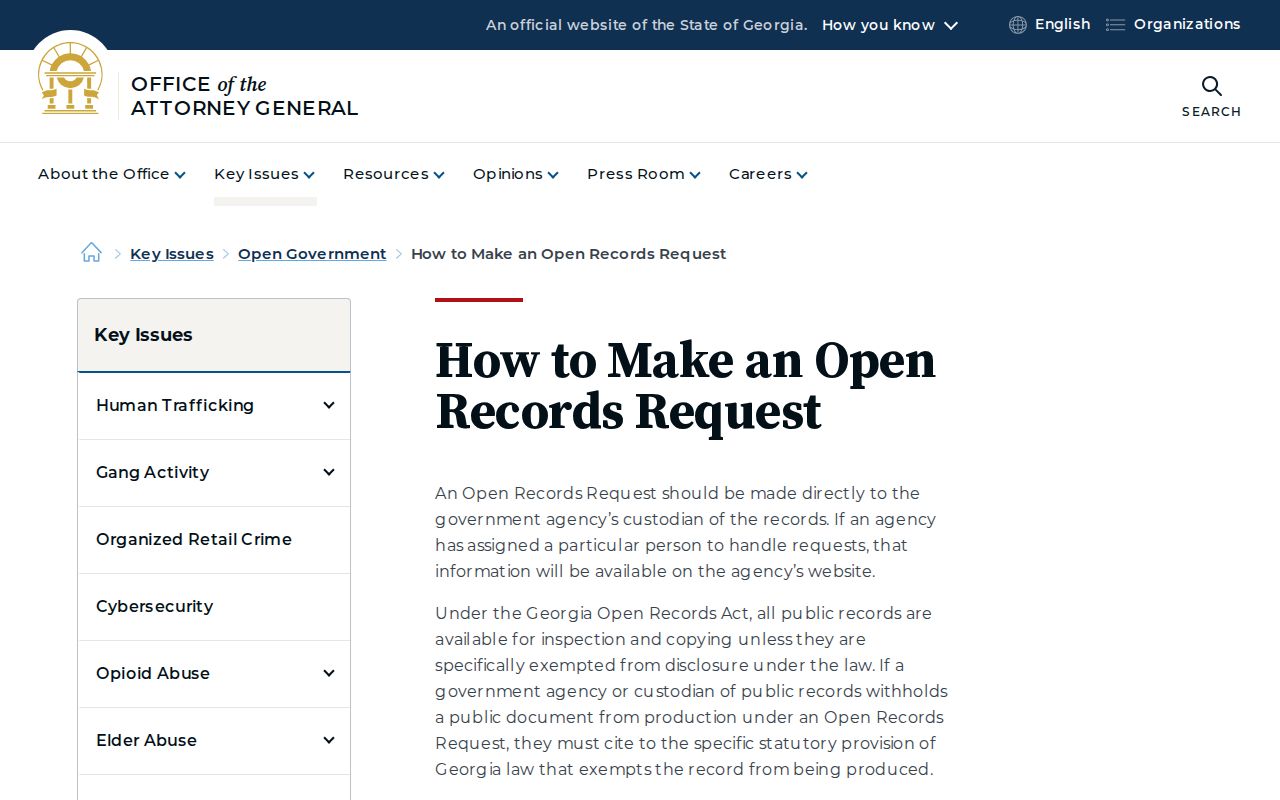
Send a written request for court papers straight to the clerk who holds them. Name the court and the case number. Add the document, the date range, the format you want, and how to reach you. State law sets the clock. Under O.C.G.A. §§ 50-18-70 and 50-18-71, an agency must usually produce the records or explain a delay. The window is a reasonable period not exceeding three business days. That deadline starts a response, though, not a finished copy order on day three.
Certified Copies and Fees
Schley County posts no current fee schedule for Superior Court copies. The price of a plain copy, certified copy, exemplification, search, or transcript is not public. The Probate office publishes no copy or certification fee either. PeachCourt document fees are likewise unstated. The old Magistrate filing schedule is no substitute. It covers warrants, suits, service, garnishment, and subpoenas rather than a full copy menu.
| Schley record item | Published amount | Best next step |
|---|---|---|
| Superior plain or certified copy | Not published | Ask Kimberly McKinney |
| Probate plain or certified copy | Not published | Ask the Probate office |
| PeachCourt document image | Not visible before login | Confirm in the service |
| Transcript | Not published | Ask the court reporter |
| Search, postage, or exemplification | Not published | Confirm before mailing |
Before mailing a records request, ask a few practical questions. Must payment ride along with it? Will the clerk quote a page count first? Confirm the accepted payment types and identification needs. Ask about postage, processing time, and the exact certification you want. And never mail an irreplaceable original unless the clerk expressly tells you to send it.
Schley eCertification by Code
GSCCCA eCertification offers another way to get certified copies in digital form. Its public page walks through the steps. You pick a county, register a universal account, sign in, and submit the request. The site itself does not confirm whether every county takes part. Nor does it state what each certified copy costs. For a Schley County case, check with the clerk before counting on it.
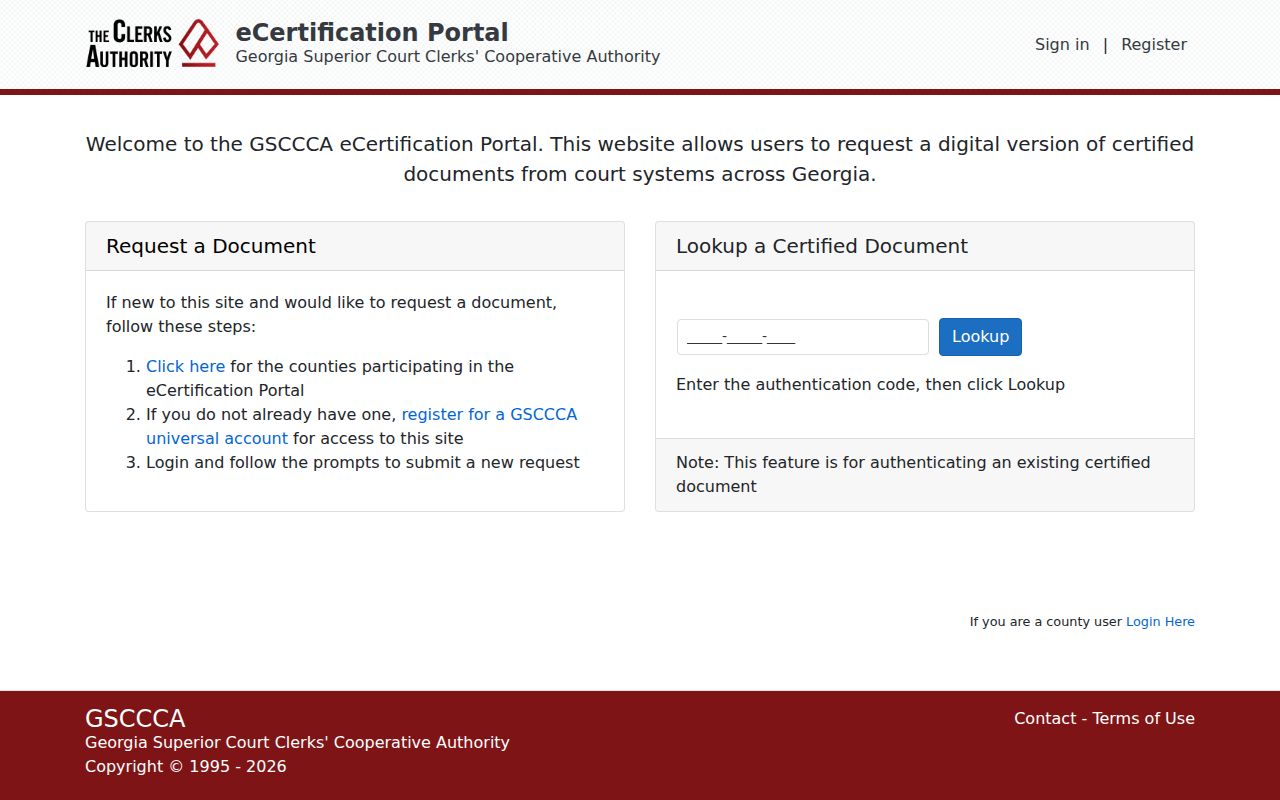
The service also handles authentication once a certificate is issued. Each certificate carries an authentication identifier in the form XXXXX-XXXXX-XXXX. A recipient can run that code through a lookup tool or scan a supplied QR code to verify it. Passing authentication confirms the certificate is genuine. It does not mean every Schley County court record can be ordered through the platform.
Public Access and Sealed Records
Schley County Superior Court records sit open to the public. The authority is Uniform Superior Court Rule 21. That is the default. A specific law or a qualifying order can still wall parts off. Rule 21.6, along with Rule 36.17, governs how protected personal information gets handled and redacted in electronic filings.
Openness has limits worth knowing. You cannot demand Social Security numbers, full birth dates, or financial account numbers. Sealed papers stay sealed, and confidential juvenile and adoption material is off the table too. Even so, a docket entry can stay visible in a Schley County court docket search. The underlying image may be withheld or partly redacted. So what you see listed is not always what you can pull.
Key Georgia rules: Uniform Superior Court Rules 21, 21.6, and 36.17 govern access, identifiers, and redaction. O.C.G.A. §§ 50-18-70 and 50-18-71 set Georgia Open Records Act access, response, exemption, and cost principles.
A missing case? Check the court, the year, and the spelling. The account gate or an older paper file can also hide a Schley County court docket entry. Some records need standing or a court order, and O.C.G.A. § 35-3-37 criminal-history restriction does not seal every clerk record.
Older Schley Court Records
Schley County dates to 1857, long before anyone imagined e-filing. Georgia rules treat minutes, final-record books, and microfilm as legitimate ways to preserve court records. So a pre-digital case may call for a manual clerk search even when a docket search online returns nothing. The county has not published which years sit on microfilm, its retention schedule, where files are stored, a retrieval fee, or whether same-day service is even offered.
Bring what you can when you go. A case number helps most, plus the caption and a rough filing year. Ask the clerk whether the paper lives in a current file, a bound record, microfilm, or off-site storage. For federal matters tied to Schley cases in the Albany Division, use the Middle District of Georgia records page.
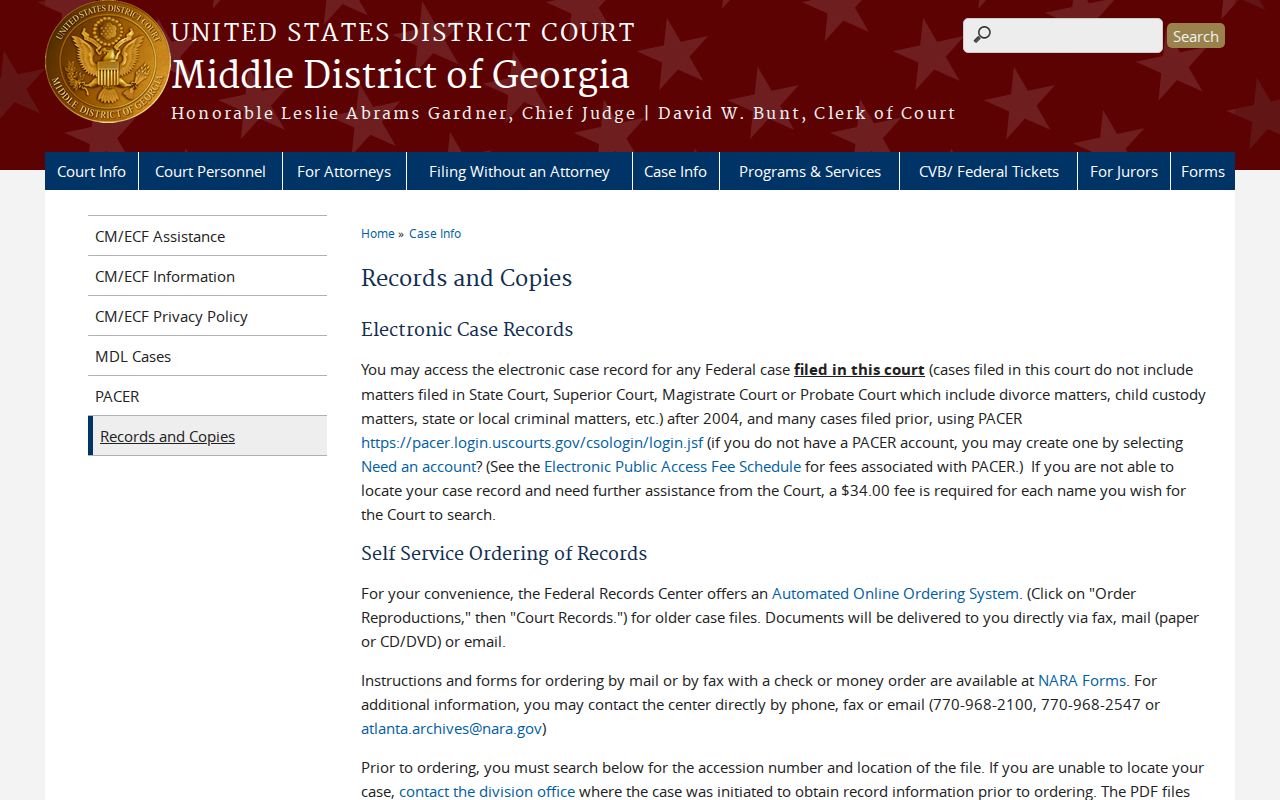
That federal procedure is no substitute for the Schley Superior Clerk. PACER and CM/ECF handle federal dockets only, while local clerks keep the state trial-court records. Match the court system to your case before you send anything, and you save yourself delay plus an unnecessary search fee.